
Why are we learning English “grammar” that the English or Americans don’t learn?
How Latin, the History of the Empire, and Institutional Convenience Invented “English Grammar”
01How English Learners Stopped Asking “Why”
A rule appears on the board:
I'm going to = I intend to, shows plans and things that are certain to happen
Twelve adults write it down.
Not children. Not people who accidentally wandered into the wrong room looking for yoga.
Adults.
A lawyer. A doctor. A finance director. A woman who manages logistics across four countries and can probably spot a fraudulent invoice by the smell of the toner.
Everyone diligently writes the “rule” down.
Nobody asks when, exactly, an intention became something certain.
There are few things in life easier to change than an intention. People intend to lose weight, go to bed earlier or stop checking their phones every three minutes.
An intention is not a certainty.
An intention is a note stuck to the fridge with a magnet.
And yet the room stays quiet.
Because this is English class.
Something odd happens to perfectly intelligent adults during English lessons. People who would normally stop a presentation over one suspicious number suddenly become extraordinarily accepting in the presence of nonsense.
The day before, some of them may even have watched a movie in which a plane was falling out of the sky and everyone screamed:
Oh my God, we're all going to die!
But no one asks:
Did the passengers intend to die? Was that the plan for that Tuesday?
And if somebody asks, the teacher always has a way out.
This is roughly how the mechanism works: the teacher teaches the rule, the textbook confirms it, the exercises drill it in, and the test rewards remembering it.
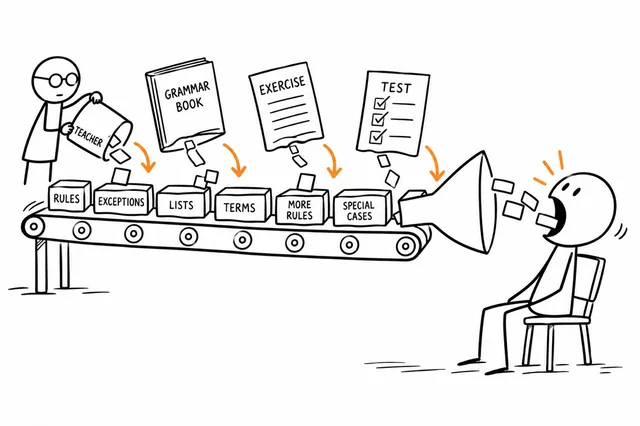
The fact that real life keeps producing English that doesn't fit becomes strangely unimportant. After all, it was in the book.
The result is that learners eventually begin to doubt almost everything: their intelligence, their knowledge, sometimes even the meaning of basic words.
The real problem is this.
The strangest part is that nobody designed this system.
It assembled itself, layer by layer, out of historical accidents, institutional needs, teaching conventions and questionable decisions going back hundreds of years.
And that's where the story starts.
02How Latin Became the Map of English
It is 1762.
Robert Lowth, an Oxford scholar, clergyman and future Bishop of London, publishes A Short Introduction to English Grammar.
The book began innocently enough. Lowth had originally prepared the material partly to help his young son understand the grammar of his own language.
But the problem was older than Lowth.
Europe already had a sophisticated apparatus for describing language — Latin.
Printed English grammars had existed since the late sixteenth century, and their authors naturally borrowed heavily from the only grammatical model they knew. For centuries, Latin had been the language of formal grammatical education. There simply wasn't another comparably established framework sitting on the shelf waiting to describe English.
And really, who can blame them?
When all you have is a hammer, everything starts looking like a nail.
English had one fairly serious flaw.
It wasn't Latin.
English is Germanic, and much of its structure works very differently.
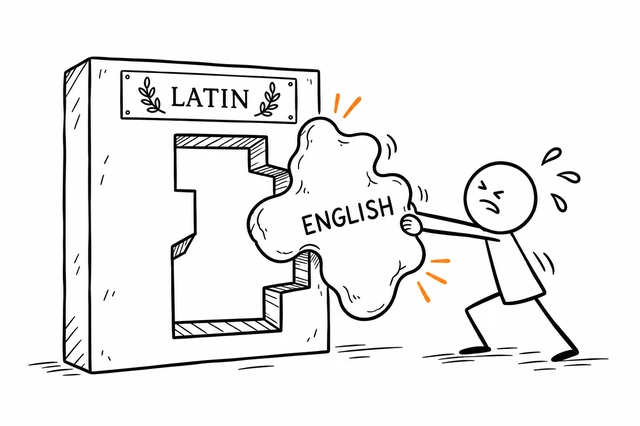
In Latin, noun endings genuinely change to show grammatical relationships. English lost most of that system long ago, so much more of the work is done by word order.
Dog bites man.
Man bites dog.
The same three words.
A radically different afternoon for the man.
Yet grammarians could still force English nouns into Latin-style case systems, even though English nouns had long since lost most of the distinct case forms those categories had been designed to describe.
English was being mapped partly through the grammar of another language.
Sometimes that map worked.
More often it didn’t.
And sometimes it produced whole layers of terminology that tell the English learner nothing about what English was actually doing.
This is the first important layer of our story. The later problem would not simply be that schools taught too much “grammar.”
The grammatical map itself had been drawn for a very different terrain.
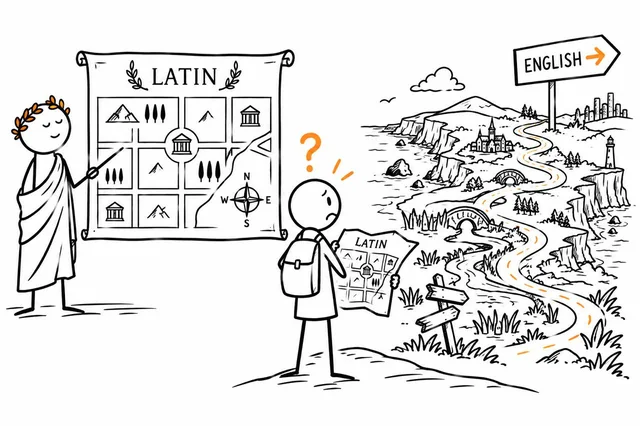
Then, toward the end of the eighteenth century, Lindley Murray helped turn this English “grammar” into something even more suitable for mass schooling.
Rule.
Example.
Correct form.
Incorrect form.
Exercise.
A remarkably convenient system for a classroom.
Not always a particularly good description of what’s really happening in English.
But extremely easy to teach.
Now all that was missing was an equally efficient way to drill the map into people’s heads.
Fortunately, Latin could help with that too.
03How We Started Teaching a Living Language Like Half-Dead Latin
Latin gave English more than part of its grammatical map.
It also gave it a lesson format.
When modern languages increasingly entered European schools in the late eighteenth and nineteenth centuries, teachers did not start from scratch. They already knew what learning a language looked like.
They had been doing it with Latin for centuries.
Latin occupied an unusual position by then. It remained important in the Church, education and scholarship, but it had long ceased to be the ordinary language of people. In school, students learned it largely through “grammar,” formal analysis, reading and translation.
When that model was transferred to living languages, the underlying idea of what it meant to “learn a language” traveled with it.
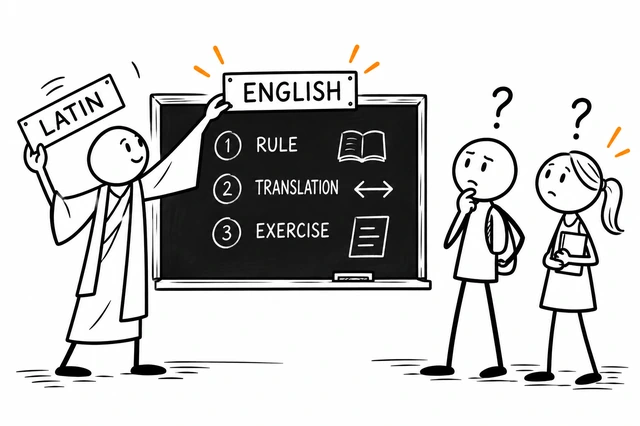
Authors such as Meidinger, Seidenstücker and later Karl Plötz helped formalize and produce materials for the tradition that eventually became known as the Grammar-Translation Method.
Its educational goals were straightforward enough: learn “grammar” and vocabulary, read, write, translate, pass examinations.
Spontaneous conversation was not the main event, or even an event at all.
The system had another enormous advantage: it did not require the language teacher to be a fluent speaker of the language they taught.
That was no small matter.
The model worked in large classes, tolerated uneven teacher proficiency and was beautifully suited to a school system that liked answers to be “clearly” right or wrong.
Apply the rule correctly and everyone knows where they stand.
Which also explains some of the immortal practice sentences preserved from that tradition:
The philosopher pulled the lower jaw of the hen.
and:
The cat of my aunt is more treacherous than the dog of your uncle.
Not because nineteenth-century Europe was facing a serious crisis involving treacherous cats and philosophers assaulting poultry.
The sentence existed to practice a form.
Meaning was secondary.
And now the two stories connect.
First, English inherited a grammatical map that did not fit it terribly well.
Then schools inherited an extremely efficient system for teaching people how to navigate that map.
This leaves us with one of the most durable ideas in language education:
And the system was wonderfully easy to organize.
Which mattered, because the demand for English was about to explode.
04The Empire Needs English for Work, Not Conversation
The British Empire expanded enormously during the nineteenth century.
And enormous empires have surprisingly boring problems.
Administration.
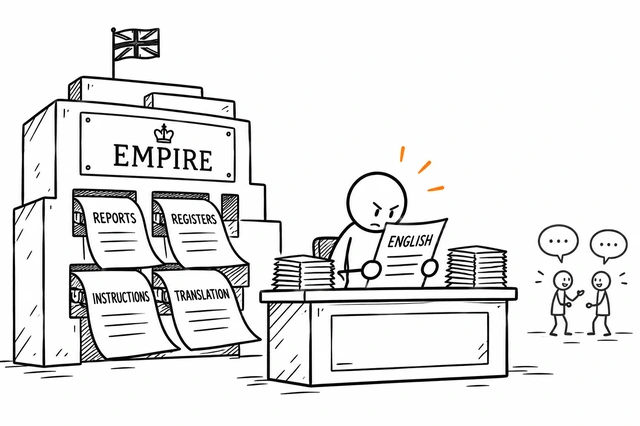
Reports. Registers. Instructions. Correspondence. Translation. Offices.
You cannot run territory on that scale with a handful of British officials. You need local clerks, teachers, translators and intermediaries capable of functioning inside an English-language administrative system.
India provides the best example.
Thomas Babington Macaulay’s Minute on Indian Education of 1835 did not introduce English to India, but it became an important part of the shift in British educational policy toward English. Over the following decades, English gained increasing importance in administration and higher education.
And suddenly the existing educational model does not look particularly ridiculous.
In an administrative system that placed a premium on reading, writing, translation and textual accuracy, a model built around text, “grammar” and accuracy had obvious practical value.
It does not necessarily produce linguistic virtuosos.
But that was not necessarily the job.
A clerk has work to do.
He does not need to spend his evenings impressing the governor with his eloquence.
The system was especially well suited to producing literate clerks and intermediaries who could function inside an English-language administrative system.
And this matters because the system did not survive for generations simply because everybody involved was stupid.
For a long time, it was good enough for the institutions using it.
The problem comes later.
The empire begins to disappear.
English does not.
After the Second World War, it acquires new engines: the United States, science, international business, technology and popular culture.
Later, the internet.
English is no longer required mainly by officials, elites and people operating inside one imperial bureaucracy. It becomes a language of work, study, conferences, travel, entertainment, trade and communication between people from completely different countries.
The task changes drastically.
Millions of people no longer want merely to read English and produce acceptable written documents.
They want to use it normally, like real humans.
Unfortunately, the old infrastructure is already a very large machine with considerable momentum.
05The “Grammar” English People Don’t Learn
This is where the story gets genuinely strange.
By the twentieth century, two very different things begin to travel under the name “English grammar.”
One is the kind of grammatical analysis native speakers may encounter at school: how sentences are structured, how words relate to one another, how their own language works.
The other is an increasingly elaborate pedagogical grammar being built specifically for foreigners.
And even the first kind — formal grammatical analysis in native-speaker schools — had already started disappearing from English schools in the early twentieth century, and it is not hard to see why. In 1921, an official report on the teaching of English pointed to a rather fundamental problem: even specialists could not fully agree on what English “grammar” actually was, or what part of it schools were supposed to teach.
There was another problem too. It was becoming increasingly difficult to show that parsing sentences, learning grammatical terminology and memorizing rules actually made people better writers or speakers.
So over the following decades, schools gradually backed away from formal “grammar.”
And somehow, English people continued speaking English.
And then something beautiful happened.
While native speakers were learning less and less formal “grammar” about their own language, we were building an increasingly elaborate version for foreigners — and around it, what would become a huge English Language Teaching (ELT) industry.
The old map was already lying on the table: Latin-derived categories, school analysis, rules of correctness, language divided into forms.
Now we added more terminology, more “uses,” more distinctions and more teaching schemas.
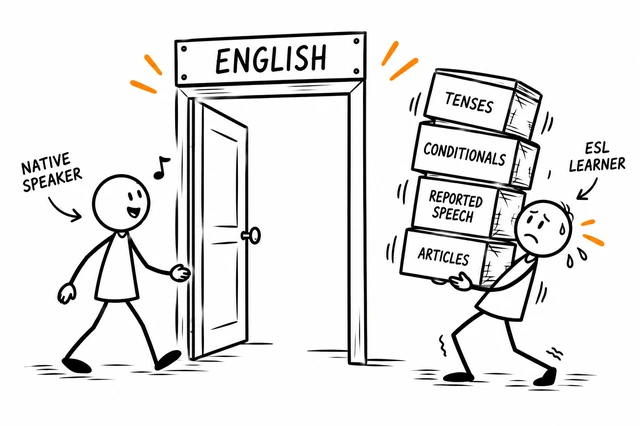
This is when things that a Polish learner today may take for the natural anatomy of English begin to crystallize into familiar classroom objects:
will vs going to.
Four Conditionals.
Reported Speech.
Not because somebody in the twentieth century invented will, going to, the Present Perfect or sentences with if.
A good example is W. Stannard Allen.
In 1947, he published Living English Structure: A Practice Book for Foreign Students.
The title already tells you quite a lot.
This was a book for foreigners.
And Allen presents three main conditional patterns corresponding to what would later become the familiar school categories:
First Conditional.
Second Conditional.
Third Conditional.
What is interesting is that Allen himself clearly knew English did not stop there. A few pages later, he includes a separate section called:
Other types (apart from the three main types).
So even in the book from which the famous school table develops, there are perfectly normal conditional sentences that do not fit inside it.
The real problem begins when three main patterns start being taught as if they were the entire system.
Take a completely ordinary sentence:
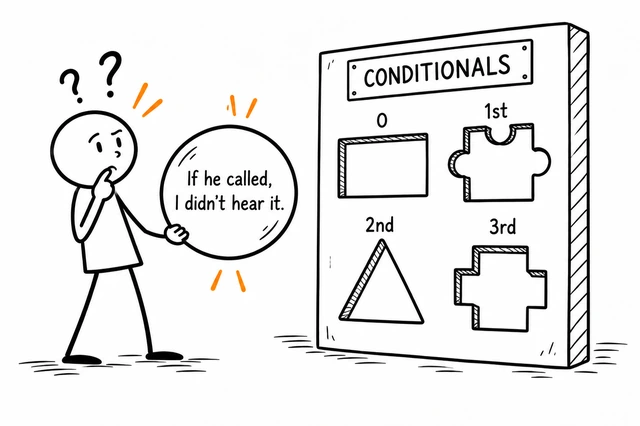
If he called yesterday, I wasn’t here.
I do not know whether he called.
Maybe he did.
Maybe he didn’t.
It is simply a real condition referring to the past.
Now try putting it into the famous 0–1–2–3 system.
Zero Conditional?
No.
First?
No.
Second?
No.
Third?
Also no.
So the standard school taxonomy has no obvious place for a completely normal condition about the past.
The language does not have a hole.
The table has a hole.
And this is where the deeper problem becomes visible.
We start with several patterns.
We give them numbers.
Then we teach people that the numbers are “grammar.”
Something very similar happens with “the future.”
Will exists.
Going to exists.
The Present Continuous exists.
But instead of first explaining what each of these constructions actually means, we place them next to one another in a chapter called Future Forms and assign them functions.
Will — spontaneous decisions and less certain future events.
Going to — intentions, plans and a more certain future.
Present Continuous — arranged plans.
So the old, imperfectly fitted map begins filling up with more and more boxes, each carrying another set of little, sometimes absurd, rules to remember.
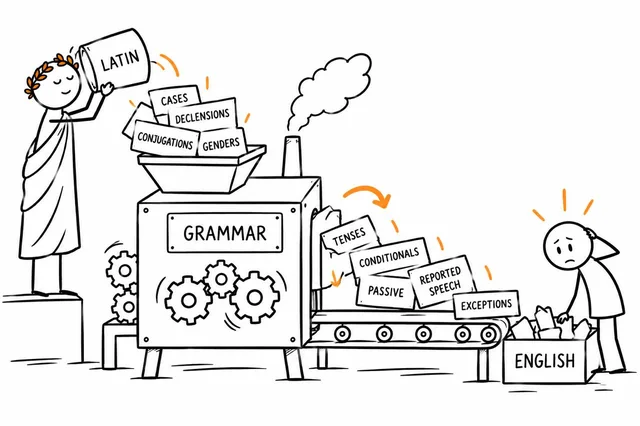
And eventually those boxes are presented as if this were how English itself was built.
Which creates the next problem.
Once the language has been divided into this many strange boxes...
How are you supposed to remember which rule goes with which box?
06The Cheat Sheet Replaces Meaning
Easy.
Give the learner more rules, plus clues for recognizing them.
Present Simple?
Habits. Routines. With adverbs of frequency such as always, never, often, rarely, etc.
Present Continuous?
Something happening at the moment. Now.
Present Perfect?
Experiences. Visible results. Since. For.
And so the cheat sheet is born.
Spot the keyword, choose the tense.
You do not have to understand what the sentence is showing. You just have to recognize the signal and match it to the correct construction.
Unfortunately, words are not road signs permanently assigned to particular tenses.
I’ve lived here since 2019.
Since you’re here, let’s start.
Same since.
Completely different job.
Or:
I’m working from home now.
I work from home now.
Same now. Both perfectly normal English. Different meanings.
Learners trained this way for years begin approaching sentences like detectives looking for fingerprints.
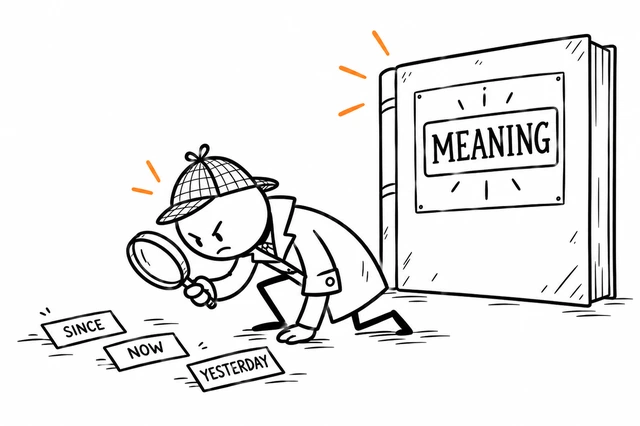
Since? Present Perfect.
Now? Continuous.
Yesterday? Past Simple.
And it works.
Sometimes.
Often enough to make the whole idea feel quite convincing.
When it stops working, we don’t usually throw away the shortcut.
We add rules.
“Stative verbs don’t appear in Continuous.”
Until someone says:
I’m loving it.
I’m seeing someone.
You’re being ridiculous.
“Will is used for spontaneous decisions.”
Until someone says:
I’ll always love you.
Which probably isn’t a decision made three seconds ago while standing in the supermarket checkout line.
And at this point the system does something it is exceptionally good at.
It does not discard the bad rule.
It adds an exception.
Then another.
After several years, the learner has accumulated an impressive collection of rules, keywords and exceptions while still having very little idea what many of the constructions actually mean.
There is only one reasonable conclusion left:
But the system?
The system is doing great, because now “learning” can be measured with impressive precision.
07The First Cambridge English Exam. Nobody Passed. So It Worked.
In 1913, Cambridge held the first Certificate of Proficiency in English examination.
It lasted roughly twelve hours.
Three candidates turned up.
Nobody passed.
Seems like it’s working.
But the best detail is buried in the report.
All three candidates were described as speaking with considerable fluency, ease and accuracy.
All three performed badly in phonetics.
In other words, you could apparently speak English quite well.
You just couldn’t pass English.
Half a century later, TOEFL appeared.
The original 1964 examination is a nice snapshot of how language competence was often conceptualized at the time.
If language can be divided into components, you can test the components.
Vocabulary.
Reading.
Listening.
Structure and “grammar.”
Early TOEFL did exactly that, largely through discrete multiple-choice items, without directly testing ordinary extended speaking and writing.
TOEFL later changed enormously. Writing and speaking assessments were added, and in 2005 TOEFL iBT introduced integrated tasks and placed much greater emphasis on communicative ability.
The tests evolved.
But one awkward mechanism remained.
When an exam matters, people teach toward the exam.
Testing researchers call this washback or backwash: assessment changes what teachers teach and what students learn.
And the loop closes neatly.
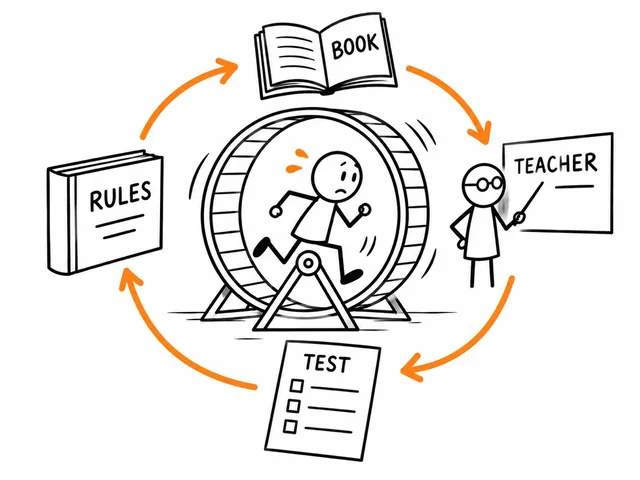
The textbook teaches the categories. The teacher teaches from the textbook. The examination rewards the categories. The learner studies them for the examination.
Then the examination result appears to confirm that these were exactly the categories worth learning.
Suddenly, the badly fitted Latin map, embedded in a system built over centuries to teach a half-dead language, starts to look like one beautifully coherent system.
The book says it.
The teacher says it.
The exam says it.
08A Hundred Years of New Methods. The Same Old Map.
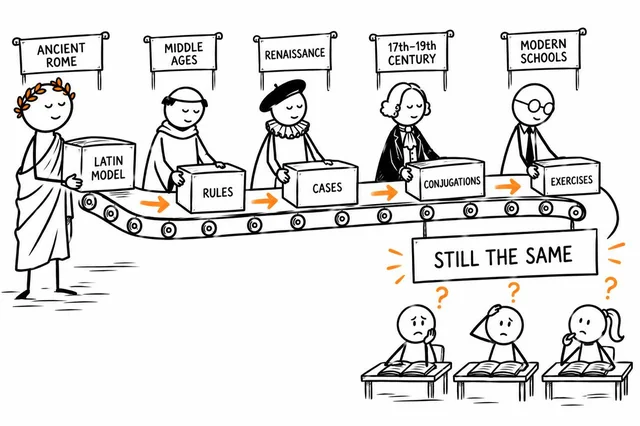
People did notice that something was wrong.
Beginning with the Reform Movement in the late nineteenth century, followed by the Direct Method and then a parade of twentieth-century approaches — Audio-Lingualism, the Silent Way, Suggestopedia, Total Physical Response, Communicative Language Teaching, the Natural Approach, the Lexical Approach — language educators repeatedly tried to repair what previous systems were doing badly.
Not enough speaking?
Speak more.
Too much translation?
Remove translation.
Too much conscious analysis?
Build automaticity.
Not enough genuine communication?
Make communication the point.
Many of these ideas were sensible, and some changed language teaching enormously.
But there is an important difference between changing how a language is taught and changing the explanation of the language underneath it.
Some methods reduced translation. Others prioritized speech, automaticity, communication, input or vocabulary. Some pushed explicit “grammar” almost completely out of the lesson.
But removing the old grammatical map from the center of the classroom is not the same thing as replacing it with a better map.
You could remove translation, speak from lesson one, introduce recordings, pair work, role-play, communication tasks or almost eliminate explicit “grammar” teaching altogether.
But when the learner eventually asked:
the same old map was often waiting underneath: rules, exceptions and structures no one could logically explain.
And this is where the story becomes especially interesting. Because by then, some linguists had already begun questioning one of the fundamental assumptions beneath that machinery: the idea that grammar is primarily form, while meaning is something added on afterwards.
From the 1960s onward, Michael Halliday developed a functional approach in which language was fundamentally understood as a resource for making meaning.
Later, Ronald Langacker's Cognitive Grammar went further and treated grammar itself as meaningful.
In other words, people were already looking underneath the bad map.
But those ideas developed primarily inside linguistics.
The average English learner did not get Langacker.
The average learner got the Conditionals table.
By then, the traditional system had too much momentum. Replacing it would require rewriting materials, rebuilding curricula, retraining teachers and changing assessment.
Who wants to do that?
It was much easier to change the method than to redraw the grammatical map underneath it.
And that is why, in 2026, you can walk into an extremely modern English lesson.
An app. A podcast. AI. Or some progressive language school.
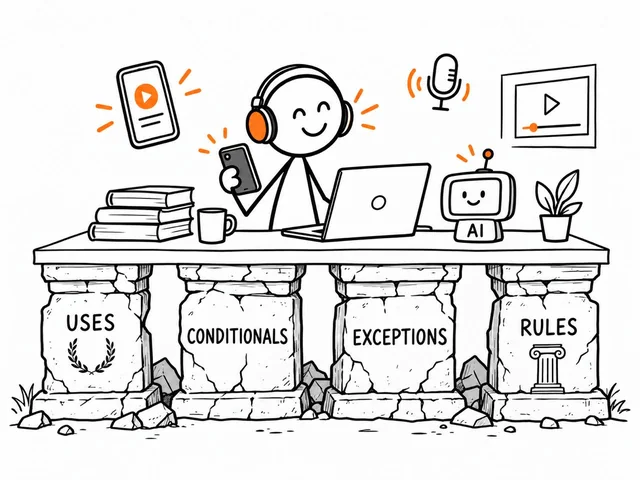
Then you open the next unit:
PRESENT PERFECT — WHEN DO WE USE IT?
Or “grammar” disappears almost completely and you are simply informed that certain words “just go together.”
Two apparently opposite answers to the same unresolved problem.
In one, you memorize the rule.
In the other, you memorize the chunk.
Somewhere between them sits the same unanswered question:
And perhaps that is why we have managed to invent new teaching methods for more than a century while learners still spend years studying English and complaining that its “grammar” is impossible.
09What If We Start With “Why?”
Remember the twelve adults from the beginning?
You now know something they did not.
You know why the rule on the board doesn’t work.
And now, you have some idea how it ended up there.
What sits behind that rule is a few hundred years of accumulated layers: a grammatical map borrowed from another language, a school system built to teach that map efficiently, new pedagogical boxes created specifically for foreign learners, shortcuts for navigating the boxes, examinations that reinforced them, and a century of teaching reforms that changed the lesson much faster than they changed the bad “grammar” approach the learner was ultimately given.
Meanwhile, the twelve adults still assume they are the problem.
You no longer have to.
Because one question is enough to start pulling the system apart:
And is there an AntiMethod to all these methods?
Apparently there is.
If you want to see what it looks like when we start with “why,” the next part of the story starts here:
SEE THE ANTIMETHOD →